
Towards a segmented and differentiated supply chain
“We cannot serve all our customers in the same way.” This old saying still rings true and comes from plain common sense.
By classifying your sales, you can identify a few homogeneous groups of customers with similar purchasing behaviours. Using this simplified matrix, illustrated with animals, you can establish differentiated service levels and processes.
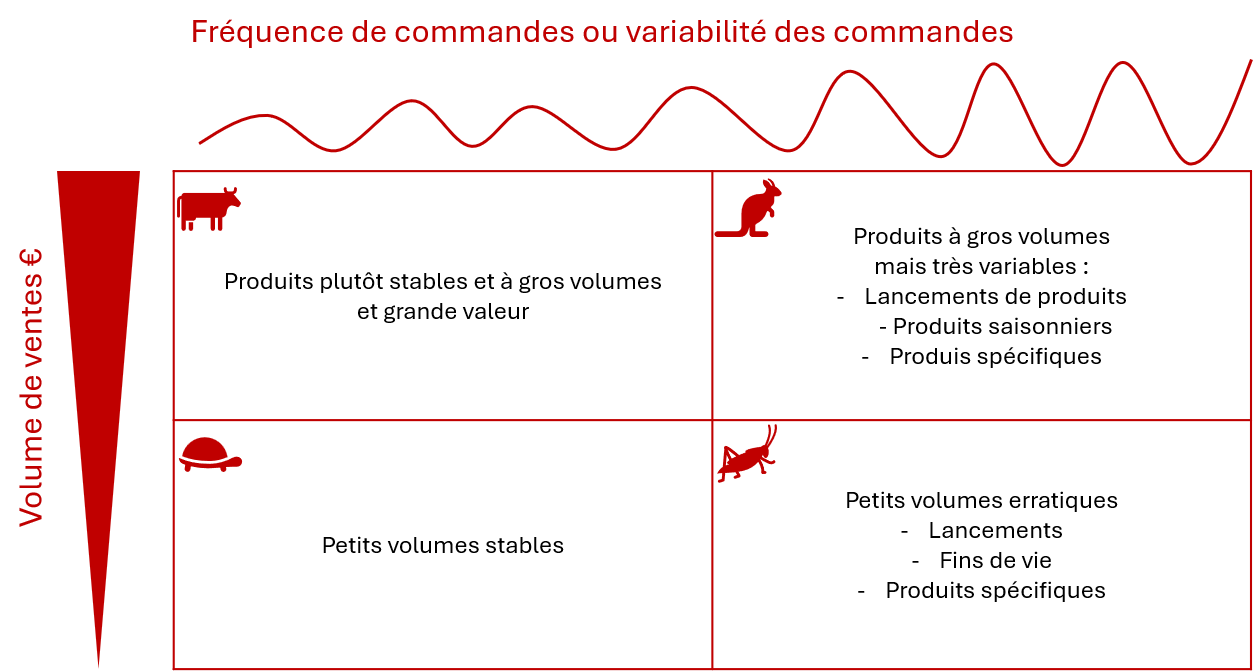
Large, regular customers
They should be highly predictable. Their regular activity makes it possible to hold just enough stock to deliver the best possible service level.
Small, regular customers
They do not disrupt flows very much, but forecasts are harder to establish. A traditional reorder point can ensure a minimum level of service.
Large, irregular customers
These are the most difficult to manage. Either adapt your customer promise and move them to make-to-order (MTO), or assess the risks and anticipate part of their demand. This is where decoupling points come into their own.
Small, irregular customers
They receive the service level you can provide, but remain the lowest priority.